

Culinary adventures in Morocco's Atlas Mountains
A Kasbah Tamadot food story
There is a particular kind of quiet that settles over the High Atlas as the road climbs out of Marrakech. The souks and scooter horns fall away, replaced by walnut groves, terraced orchards, and the distant clang of goat bells drifting down from villages that have barely changed in a century. This is Morocco's culinary heartland hiding in plain sight and Kasbah Tamadot, Virgin Limited Edition’s mountain retreat, is the perfect base from which to eat your way through it.

In 2025, Kasbah Tamadot was awarded Three MICHELIN Keys, one of only 143 properties worldwide to receive the accolade in the inaugural Global MICHELIN Key selection, recognising it as an extraordinary stay and one of the world's most remarkable hotels. It's a fitting honour for a retreat built on the flavours, rhythms, and generosity of the valley that surrounds it.
A region built for slow food and long views
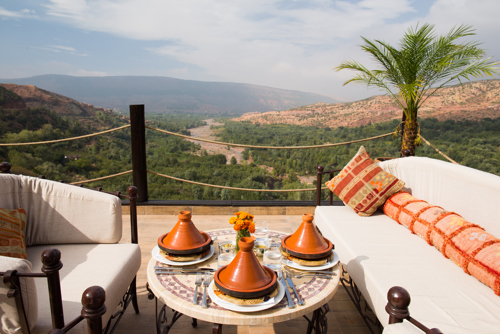
Forty-five minutes from Marrakech's medina, the Asni Valley unfolds beneath Mount Toubkal, North Africa's highest peak. This is Berber country, where saffron fields, apple orchards, and wild thyme grow at altitude and where cooking has always followed the seasons rather than a menu. Villages along the valley sbake bread communally, gather walnuts by hand and still send mint down from mountain streams to flavour the national drink.
It's a landscape made for culinary wandering. A morning trek toward Toubkal's foothills might end at a roadside stall selling msemen, warm and dripping with honey. An afternoon in Marrakech's spice souks means threading past mountains of cumin, cinnamon bark, and dried rosebuds before returning to the cooler air of the mountains by evening. Kasbah Tamadot sits at the centre of all this, close enough to the city for a spice-hunting expedition, remote enough that the valley's own produce ends up on your plate the same day it's picked.
The valley itself does a lot of the cooking before anyone even lights a stove. Argan oil, pressed from the nuts of trees that grow almost nowhere else on earth, turns up drizzled over bread and stirred into amlou. Olive groves terrace the lower slopes, honey comes from hives tucked into the hillsides, and saffron - some of it grown just a few hours south in Taliouine - finds its way into everything from a simple chicken tagine to a bowl of harira at sunset. Village souks along the valley, smaller and slower than Marrakech's, are where a lot of this produce still changes hands: stallholders selling walnuts by the sack, mountain apples, and preserved lemons that have clearly been someone's family recipe for a very long time. It's not a food scene built for cameras but simply how the region has always eaten, and tasting your way through it feels like being let in on something rather than sold something.
The scent of fresh bread, wherever you are
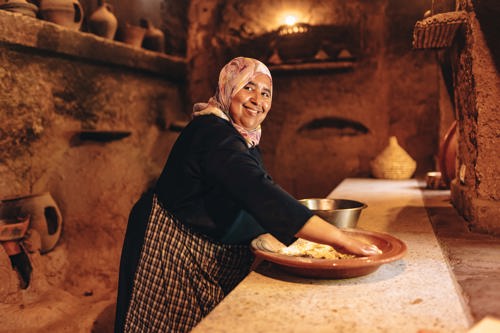
Ask anyone who has spent time in the Atlas Mountains what they remember most, and bread comes up almost every time, not as a dish, but as a backdrop. Khobz, the round, hand-torn Moroccan bread, appears at every table across the region, baked that morning in wood-fired ovens and served warm enough to steam. It's less an ingredient than a ritual: bread as the utensil, the appetiser, and the punctuation mark at the end of a meal.
At Kasbah Tamadot, that same rhythm carries through the property. Loaves come from a traditional clay oven on site, and the smell of them baking drifts across the gardens most mornings; a small, constant reminder of exactly where you are. It's the kind of detail that doesn't need explaining. You simply notice, one morning over breakfast, that the bread tastes like the valley itself.
Atay: the ceremony of Moroccan mint tea
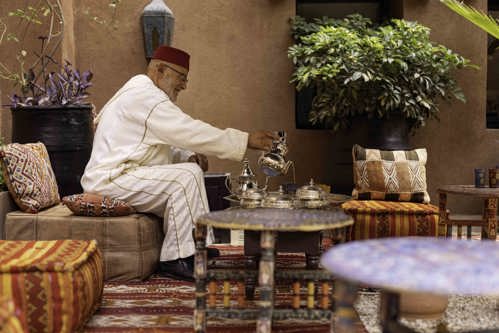
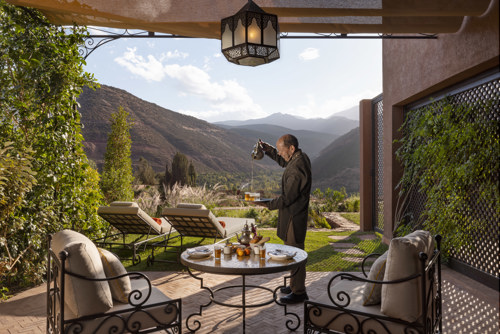
If bread is the backdrop, mint tea is the punctuation of Moroccan life. Atay is poured everywhere in this region, in Marrakech's souks between haggling over rugs, in mountain villages as a welcome to strangers, and at Kasbah Tamadot as an afternoon ritual best enjoyed on a terrace overlooking the Atlas foothills.
The theatre is part of the pleasure: green tea leaves rinsed, fresh mint bruised to release its oils, sugar added with real conviction, and the whole thing poured from a teapot held dramatically high above the glass to build a frothy top. Guests are often invited to try the pour themselves, usually with a laugh and at least one small spill. It's a small ceremony, repeated constantly across the region, and it says something true about Moroccan hospitality: that taking time over small things, again and again, is its own kind of luxury.
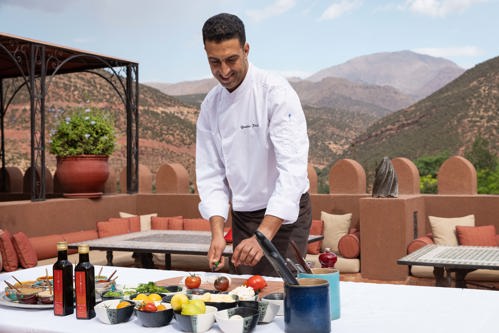
Cooking classes at Kasbah Tamadot, with the valley as the pantry
The most direct way into this region's food culture is Kasbah Tamadot's own hands-on cooking classes, held in a kitchen designed for exactly this kind of joyful mess. The hotel’s culinary team - many from Berber villages just down the valley - share the essentials of Moroccan cooking at a relaxed pace: how a good tagine is built, why sweet and savoury sit so comfortably together in a lamb and prune tagine, and what goes into a proper ras el hanout. It feels less like a class and more like being let loose in someone else's kitchen for the afternoon.
It helps that the ingredients are the real thing. Herbs and vegetables come from the kasbah's own gardens; spices and produce can be sourced from Marrakech's souks for guests keen to shop before they cook. Either way, the story of the meal starts close to the earth it grew from and finishes with the kind of table you'd hope to be invited to, not just seated at.
The Atlas Mountains: Morocco's quieter culinary story
Marrakech gets most of the attention when it comes to Moroccan food, but the Atlas Mountains have their own quieter story to tell; one that's unhurried, seasonal, and deeply rooted in place. Saffron, walnuts, wild honey, and mountain-grown vegetables define the region's flavour, shaped by altitude and season rather than trend. Staying at Kasbah Tamadot means access to both worlds: the souks and spice markets of Marrakech within reach, and the slower, valley-grown version of Moroccan cooking right outside the door.
Plan your own Moroccan culinary adventure
A trip built around Kasbah Tamadot is really a trip built around the Atlas Mountains and the culinary culture that surrounds it: Marrakech's souks within striking distance, mountain villages baking bread the way they always have, and a Three MICHELIN Hotel Key retreat in between, ready to bring it all together over a pot of mint tea and a tagine still bubbling from the coals. Book a stay, book a class, and let the valley do the rest.


Even more inspiration

The ultimate Mallorca food guide: Olive oil, honey, wine & the island's tastiest secrets
From mountain olive groves and local vineyards to fresh seafood and artisan produce, Mallorca is one of the Mediterranean’s most exciting food destinations. Make Son Bunyola your base and discover the island’s must-try flavours, traditional delicacies and local ingredients that make eating your way around Mallorca an adventure in itself.

Eating your way through the British Virgin Islands
Let's be honest: you could come to the British Virgin Islands purely for the beaches and nobody would blame you. But if you leave without eating your way properly through this extraordinary corner of the Caribbean, you will have missed something rather magnificent.

Savour the Flavours: Foodie Holiday Breaks at Son Bunyola and Mont Rochelle
Son Bunyola in Mallorca and Mont Rochelle in Franschhoek, South Africa, blend breath-taking landscapes with exceptional culinary experiences, perfect for travellers who believe the best way to explore a region is through food.